Jurying Rubric – SCA Exhibitions
Framework for the Selection of Artwork into SCA Exhibitions or Elected Membership
INTRODUCTION
This document represents a framework for the process of selecting artwork for SCA Exhibitions. There are three sections to this framework:
- SCA Values and Goals
- Process for Artwork Selection into SCA Exhibitions
- Scoring Rubric
- SCA VALUES and GOALS
The SCA values and goals are important factors to consider when selecting artwork for inclusion in SCA exhibitions.
- The SCA is dedicated to fostering the visibility and stature of the visual arts throughout Canada.
- With over 500 members across the country, the SCA is a national organization that represents art supporters and professional artists who work in a diverse range of genres, media, and styles. We are an organization that welcomes both established and emerging artists.
- PROCESS for ARTWORK SELECTION into SCA EXHIBITIONS
The selection of artwork into SCA exhibitions and the determination of award recipients is in accordance with the following process:
- Defining the Eligibility, Terms, and Conditions of Entry (ETCE). The SCA Board of Directors is responsible for approving and publishing the Exhibition’s ETCE on the SCA website.
- Preliminary Due Diligence. Prior to the entry submissions being forwarded to a Jurying Panel, an Exhibition Review Team (ERT) led by the SCA’s Exhibition Director conducts a preliminary review of the entries to determine if the submissions are in compliance with the ETCE. Artwork deemed to be non-compliant will, upon Executive approval, result in the disqualification of the artist and all of their submissions into the Exhibition. The Executive will then report back to the SCA Board of Directors who will determine what, if any, further actions may be required.
- Juror Scoring. Upon completion of the preliminary due diligence by the ERT, the Jurors who are approved by the SCA Board of Directors, will review all the submissions and provide a score for each piece in accordance with the scoring rubric (see next section for details).
- Evaluate Score Cutoff for Acceptance into the Exhibition. Upon receiving the initial scoring from the Jury, the ERT will meet to determine the score cutoff for potential acceptance into the Exhibition. Consideration will be given to SCA quality standards and gallery capacity limits.
- Additional Due Diligence. Upon completion of the determination of the preliminary cutoff for artwork recommended for inclusion in the Exhibition, the ERT will conduct an additional due diligence to ensure that the artwork recommended for acceptance is compliant with the stipulated ETCE.
- Scoring Tiebreaks for Awards. If tiebreaks are required for Exhibition awards, the Jurors may be required to conduct a rescoring of the affected artwork.
- Approval of Recommendations for Accepted Artwork and Award Recipients. Upon completion of the due diligence and juror scoring, the slate of recommendations are presented to the SCA Board of Directors for their final approval.
Conflict of Interest and Code of Conduct
Persons who have an influence on the outcome of the selection process and that also have a real and/or perceived conflict of interest are required to disclose the potential conflict and recuse themselves. This would include members of the Jurying Panel, the Exhibition Review Team (ERT), and the SCA Board of Directors. For example, a Juror may not submit artwork into an exhibition for which they are a juror, a member of the ERT may not perform due diligence on their own artwork, and SCA Board Members may not approve their own artwork for acceptance and award.
Board Approved on July 23, 2024: SCA Board Members (and immediate family) are able to enter SCA exhibitions (and recuse themselves from deliberations over their work); however, they are ineligible to win awards unless the Board had pre-approved their leave of absence from the Board during the timeframe from the deliberations preceding the exhibition and until the Opening of the show.
- SCORING RUBRIC
The Jurors
The SCA selects artists and art industry professionals to be jurors for the SCA exhibitions. Out of a five person jury, at least one juror will be an SCA Elected Member. The SCA Board of Directors, as part of the juror approval process, will review the background credentials of the prospective jurors to ensure that the juror’s expertise and professional judgment will be congruent with the SCA’s values and goals. Additional consideration will be given to ensure that the Jury Panel is balanced with diverse artistic, professional, and geographic backgrounds.
The Evaluation Criteria
The jurors will evaluate each of the submissions according to the following three criteria:
- Technical Excellence:
Technical expertise encompasses a comprehensive understanding of the elements of design. Submissions will be assessed based on the artist’s mastery of technical skills, demonstrating a high level of proficiency and craftsmanship in the chosen medium. Jurors will consider the artist’s skillful technical execution evident in each artwork.
- Artistic Expression:
Artistic expression is the soul of the piece, capturing the viewer’s attention and fostering a meaningful connection. This category focuses on the artist’s ability to convey emotions, ideas, and concepts through their work. Jurors will assess the depth of expression, originality of interpretation, and the artist’s unique voice evident in the artwork.
- Creative Innovation:
Creative innovation emphasizes originality, encouraging artists to surprise and engage viewers with fresh perspectives, unconventional techniques, or novel concepts. Jurors will seek artworks that challenge norms, inspire new ways of seeing, and demonstrate a courageous willingness to explore uncharted artistic territories.
The Ranking Scale
Within the context of each artwork’s genre, medium, and style, the jurors are to use their professional judgement to give the piece a rank score for each criteria ranging from 1 – 5:
1 Unacceptable
2 Deficient
3 Baseline
4 Advanced
5 Mastery
The Jurors may also disqualify a submission for copyright violations and/or non-compliance with the Exhibition’s ETCE by providing a zero (0) score. The total score for each piece will be the summary of the score for all the three criteria.
Example
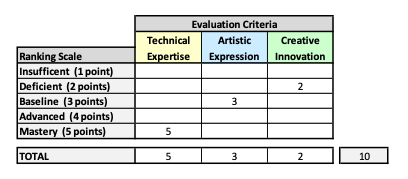
The following graphic (with a sample evaluation) provides a scoring rubric to be used by the Jurors when evaluating the Exhibition entries. For example, a piece evaluated to have Technical Expertise mastery (5), baseline Artistic Expression (3), and deficient Creative Innovation (2), would have a total score of 10.