
SUMi-e
Sumi-e (墨絵)
Capturing the Soul of a Painting
Written by Nadia Ramnarine, Curator and Director of Exhibitions
In Collaboration with SCA Sumi-e Artists Roslyn Levin, Laura Beaton & Diana Bullock
What do artists Jackson Pollock, Roslyn Levin, Laura Beaton and Diana Bullock have in common? Sumi-e, of course! Sumi-e (墨絵), Japanese for black ink “sumi” and painting “e”, took root in Japan during the 14th century after being brought by Buddhist monks from China. Evolving to a uniquely Japanese artform, Sumi-e means more than just painting: it carries the spirit of its artist and subject within its dark strokes, unpainted space and red seals. Adopted and cherished by artists beyond Japan, The Society of Canadian Artists’ Roslyn Levin, Laura Beaton, and Diana Bullock takes us through their Sumi-e artistic practices.
Roslyn Levin’s 50-year Sumi-e practice exemplifies traditional Sumi-e principles through creative processes and materials. She begins a painting first by meditating, as has been the custom for over 1400 years, a precedent that was set by monks who helped to develop ink wash painting. Then, with each deliberate breath, she makes a single paint stroke on Sumi-e paper, washi, by moving her body with the brush to create each stroke. The width of each brush stroke reflects the depth and weight of each breath with some strokes being wider with a heavier breath or narrower with a shallower breath. Paint stroke after paint stroke, the image emerges.
Laura Beaton highlights that each stroke begins and ends in one instance. There are no preparatory sketches. If the last stroke does not please the artist’s, they must choose to either continue painting to see what emerges with subsequent paint strokes, or start anew.
Rising Morning Mist was created using this process. Silhouettes of a rising sun with trees and foliage emerge from varying intensities of black ink- and– unpainted space. This unpainted space/void, or yohaku (余白), is often interpreted as emptiness or unfinishedness by some. However, in Sumi-e this unpainted space is deliberately created and is intended to work in harmony with paint strokes. Roslyn Levin explains that “the unpainted space is meant to let the painting breathe.”
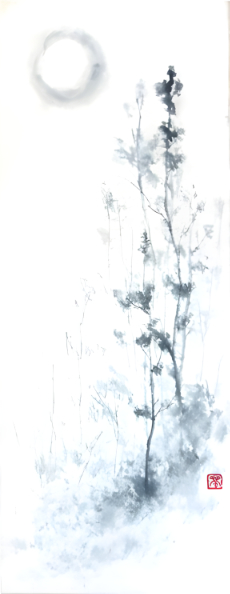
Roslyn Levin
Rising Morning Mist
Sumi on Washi
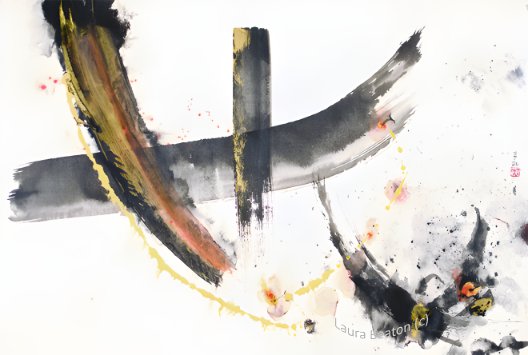
Laura Beaton
Waterlogged, 1st prize (Ruth Yamada Award, 2024)
Sumi-e on Washi, Chinese/Japanese Inks (red, black, gold)
What does it mean “to let the painting breathe”? Laura Beaton explains this concept, “The artist’s goal is to capture the ki (気) (energy or essence) of the subject matter.” The unpainted space allows the form of the subject to emerge and is a part of the painting’s composition. Yohaku also gives pause for the viewer’s eyes which allows contemplation or processing of what one is seeing or feeling.
In Waterlogged V2, bold strokes of black ink and yohaku create a harmonious movement. And there is something eye-catching: the use of coloured ink. The use of coloured ink comes from Chinese influences that began in the 7th century. In comparison, Sumi-e emphasizes the use of monochromatic black ink to work in complement with unpainted space. Laura Beaton explains this award-winning painting’s message, “This painting is not only about the coexistence of cultures, but about the role of friendship in allowing cultures to transcend boundaries. Cultural exchange cannot occur in isolation or through technique alone; it requires trust, mutual respect, and human connection.”
Laura Beaton goes all in with making Sumi-e her own with Elbows Up. She explains, “This art reflects the strength of a unified country while providing a nod to Canada’s quiet defiance and resilience during the 2025 Four Nations Hockey Tournament victory against the USA. It honours the spirit of a nation that fights not only on the ice, but also in the preservation of its values, identity, and voice off-ice. In creating Sumi-e, Laura Beaton leaves room to grow and expand into to new experiences, not unlike yohaku.
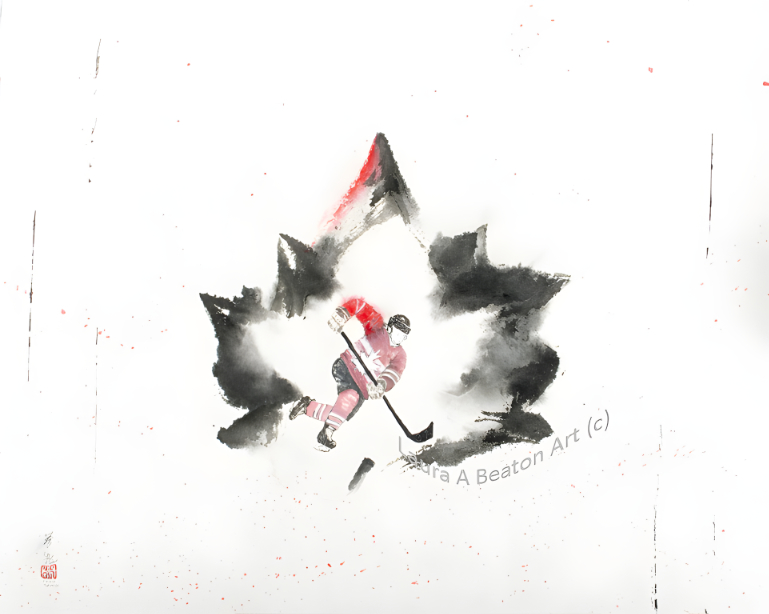
Laura Beaton Elbows Up! Sumi on Washi (Iwami Unpainted); Gallery Panel Substrate, Chinese Paint/Japanese Ink
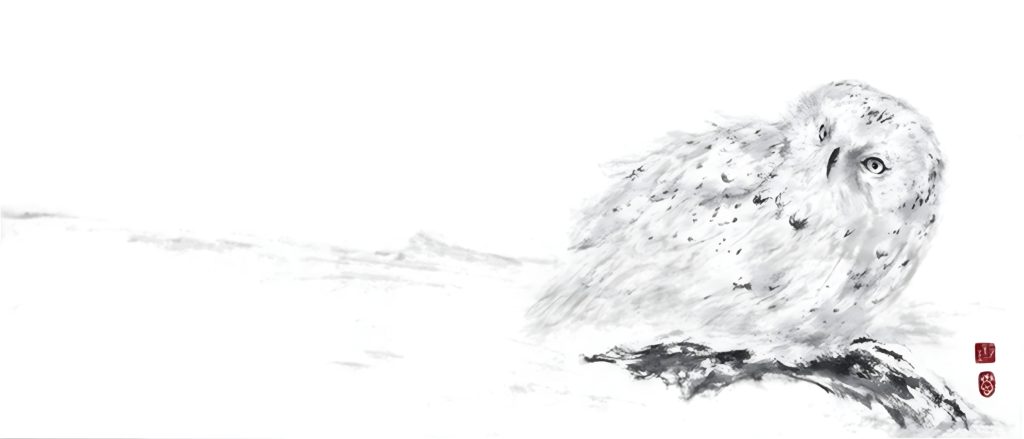
Roslyn Levin
Taking a Long View,
1st Prize (Ruth Yamada Award, 2022)
Sumi on Washi
Roslyn Levin similarly personalises her paintings through Canadian content and causes close to her heart, while using traditional Sumi-e techniques. In Taking a Long View, she speaks of climate change and its impact on wildlife that are indigenous to Canada, such as the endangered Snowy Owl. This melding of artistic practice and culture alludes to Sumi-e not only being an artform, but a way of life.
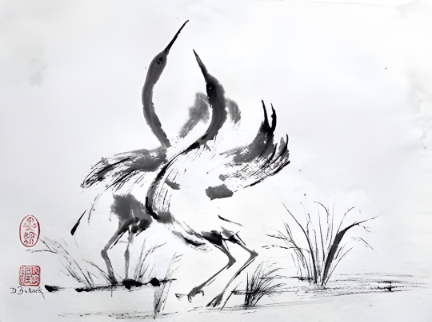
Diana Bullock
Let’s Dance
Sumi on Washi
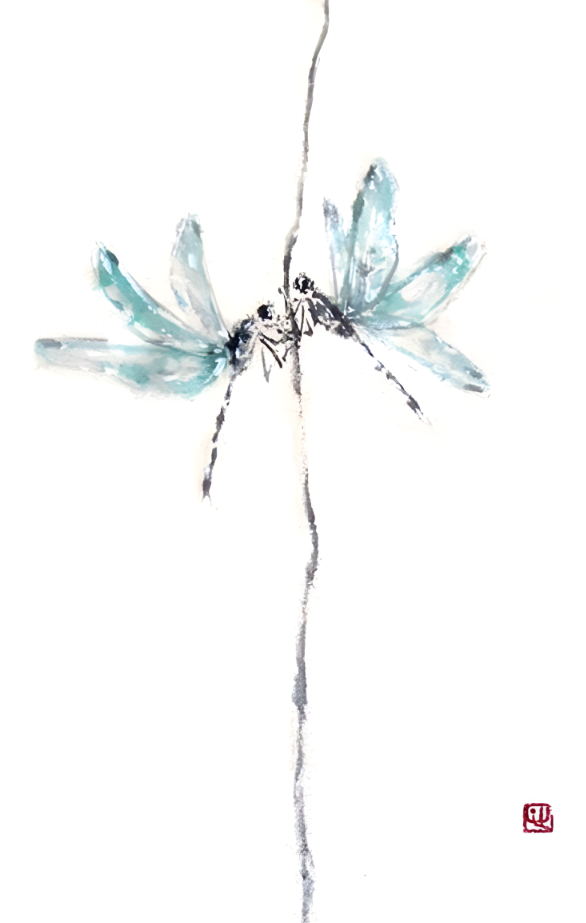
Roslyn Levin
With Every Touch
Sumi on Washi
The third essential element of Sumi-e is the inkan (印鑑 ), or red seal. The inkan is imprinted by a carved wooden or stone stamp, the hanko (判子). The placement of the seal works in harmony with paint strokes and unpainted spaces to guide the viewer’s journey. It signals the beginning of the painting and where the eyes should start to observe. The inkan is imprinted onto the Sumi-e only after it is completed when the last brushstroke is made, and unpainted spaces are settled.
Let’s Dance’s seals are on the left side of the painting, whereas In Every Touch, they are on the right. In Let’s Dance, the seals draw the viewer to the dance of the birds starting on the left side of the painting. Alternately, in With Every Touch, Roslyn Levin explains that “the inkan is at the bottom right and anchors the painting while allowing the eye of the viewer to travel up the vine, thus moving through the life of the lovers; rest with them a while; and continue along the path.”
The inkan doubly serves as the signature of the Sumi-e artist. Not an alphabetized name, but a quality or essence embodied in the artist’s character as bestowed by a Sumi-e Sensei. Roslyn Levin’s inkan in With Every Touch means “heart/mind/spirit” and her artist’s name is “Spring Water.” Laura Beaton’s inkan captures “Life Journey”, a nod to her unrelenting work ethics. Diana Bullock’s inkan carries the sentiment of “Simple Elegance”.
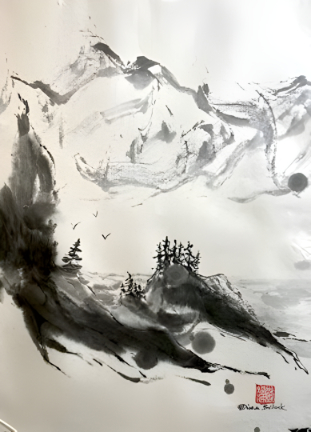
Diana Bullock
Peaceful Vista
Sumi on Washi
What is deemed mastery in Sumi-e? Diana Bullock explains that while Sumi-e may appear simple compared to other forms of paintings, it is the artist’s ability to capture the essence of the subject matter in as few strokes and least time as possible that demonstrates mastery. The artist’s intense training allows them to execute complex strokes with effortless ease in the first instance. Decades of muscle memory training and meditation on form makes painting look completely natural, even easy.
Throughout her 30-plus years of painting, Diana Bullock continues to strive for mastery by learning and refining her practice to interpret forms that emerge in each painting. In Peaceful Vista a seemingly simple stroke with a feather brush (ordinary feathers fashioned into a brush) became mountains with each deliberate gesture.
With artistic careers spanning decades, our Sumi-e artists have received international recognition. Some of Diana Bullock’s awards include Best in Show at The Scugog Art Council (2017), and she has received two Honourable Mention Awards at the SCA Open International Exhibitions (2023, 2025). Laura Beaton and Roslyn Levin are recipients of The Ruth Yamada Award for Excellence. This is the highest recognition of Sumi-e artistry in Canada with Laura Beaton receiving her award in 2024, and Roslyn Levin on three different occasions (2003, 2005, 2017, 2022 plus 5 Honourable Mentions). In addition, the American Sumi-e Society have bestowed prestigious awards to Roslyn Levin for her paintings.
Roslyn Levin is also the author of The Brush Dances (ISBN 9781999393601), a highly regarded teaching tool about Sumi-e. As a seasoned Sumi-e teacher, she looks to impart her 50-plus years of Sumi-e experience to those wishing to learn this artform, whatever their current level. For information on her courses, contact her at roslyn@artbyroslyn.on.ca.
Sumi-e Materials
Sumi-ink made of soot, animal glue, and perfume or incense
Washi – paper made of various materials including the inner bark of plants (gampi, mitsumata and kozo) which are highly absorbent of wet ink
Fude– (Brush)-animal hair
Suzuri -(or inkstone)- used to grind Sumi into powder before adding water to make paint
Generous amount of water
Sumi-e simultaneously embodies contrasts, juxtapositions and harmony with literal black paint strokes, an infinity of greys, unpainted spaces, action with conscious thought and abstract form. Abstract Expressionist artist Jackson Pollock’s “Black Pourings” mimic many elements in Sumi-e including gestural movements to create interpretative images.[1] Robert Motherwell’s “automatic paintings” in Lyric Suite are synonymous with Sumi-e’s spontaneity as were his use of washi.[2] Toni Onley’s use of all pillars of Sumi-e during the 1970s to paint Canada’s landscape resulted in an ancient artform being used in a contemporary way.[3]
Sumi-e continues to evolve in Canada. With the closure of the Sumi-e Artists of Canada organisation in March 2026, its artists are without a space to meet, paint and advance this artform. Nonetheless, true to the essence of her inkan “Life’s Journey” that captures her industrious and determined character, Laura Beaton is among the artists who are committed to finding new avenues of teaching Sumi-e. Partnering with Roslyn Levin to teach this artform in upcoming classes, they invite all to learn how to create Sumi-e with them. (Laura@LauraBeaton.com) And so, this 1400-year-old tradition that has spanned the globe to influence art in the East and West and has found a place at the SCA, will continue to flourish through the ones who have it their own.
[1] Robert Storr, A Piece of the Action (New York: Museum of Modern Art, 1999, p.57–58) https://en.wikipedia.org/wiki/Jackson_Pollock
[1] Morgan, Robert, Robert Motherwell: Lyric Suite. Brooklyn Rail (2022) https://brooklynrail.org/2022/06/artseen/Robert-Motherwell-Lyric-Suite/
[1] Boulet, Roger. Toni Onley. Toronto: Art Gallery of Greater Victoria / Beaufort Books, 1981.
Georgia Institute of Technology, Robert C. Williams Museum of Papermaking
https://paper.gatech.edu/washi/washi-history-japanese-papermaking (2026)