
Neltje Green
Neltje Green
Holding Space
Neltje Green is the recipient of the Society of Canadian Artists’ 58th Juried Exhibition: Home, 1st Award of Distinction, Contemporary category. This award is among the SCA’s most prestigious and is awarded by a jury of accomplished arts professionals for artistic excellence.
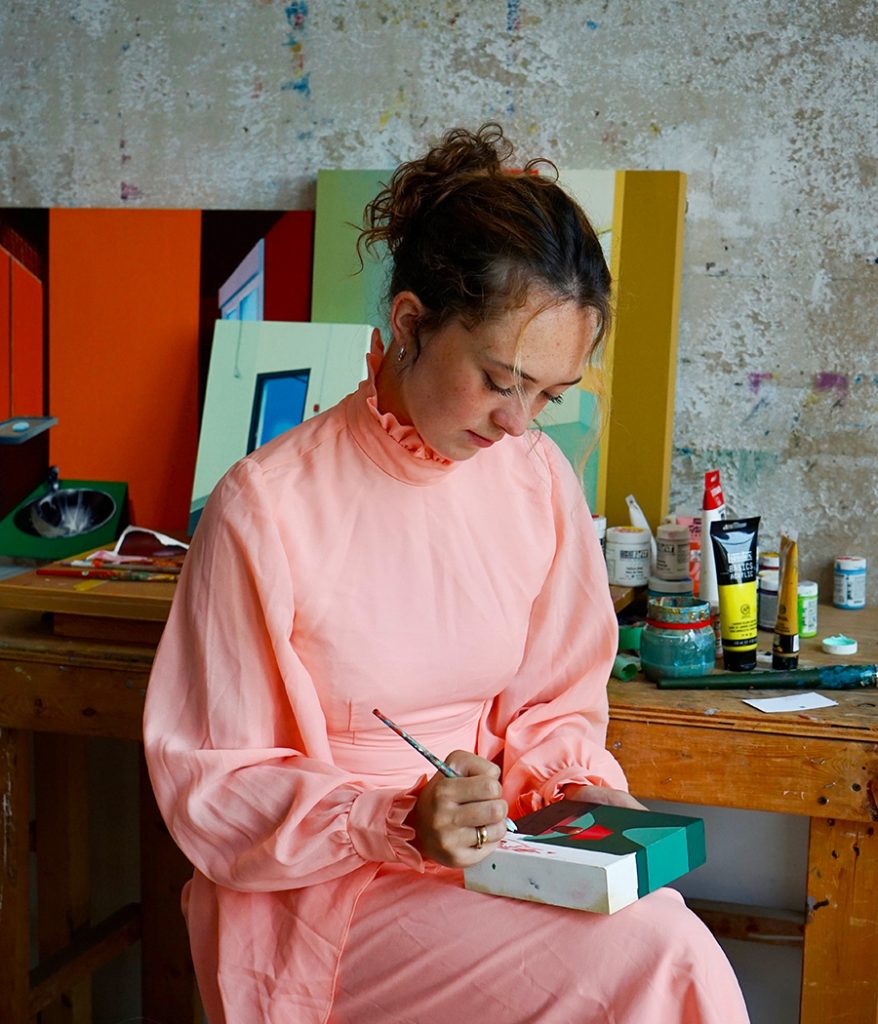
Green’s creative journey began after moving from Toronto to Montreal to pursue a Bachelor of Design degree at Concordia University in multi-media and industrial design. Her intention was to build structures for purpose. However, during her studies, a recurring concept caught her attention: the bridging of art and built structures. For her, this meant exploring how real and imagined spaces hold our memories and tell our narratives. After graduating in 2025, she cast aside aspirations of designing literal spaces and instead focused on making art. Her paintings do not include literal figures, only memories contained in their place.
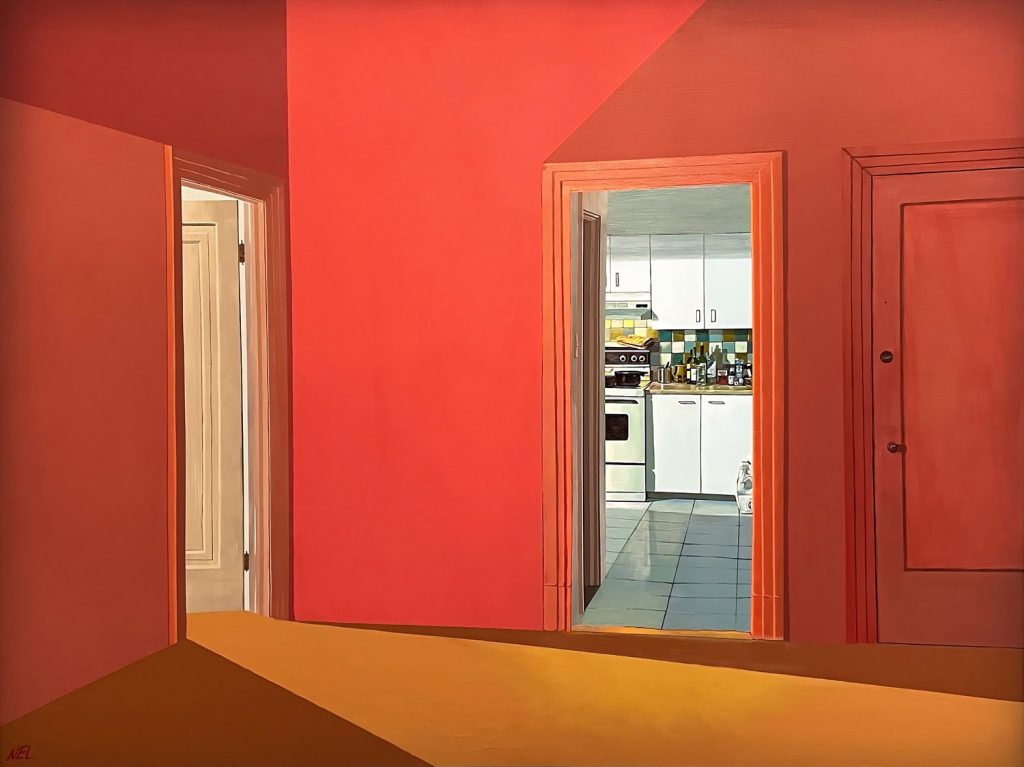
Each Time I Remember contains three rooms where two seem empty and a third is filled with kitchenware. The kitchen is viewed through an open door that connects to the foreground. Rich saffron-coloured walls and floor contrasts with calm blues and greys of the kitchen. This is Green’s first apartment and where she lived during Covid-19. The kitchen is prominent because in this space she learned to cook and nurture herself during isolation and found stability amidst uncertainty. As juror Victoria Pearce remarked, “I was struck by the strong composition of this piece that drew you into a more intimate space. The use of simple strong shapes, angles and colours against a more muted and detailed interior was intriguing and brought me in for a closer look.” A glimpse is enough to make you want to know more.
Neltje Green
Each Time I Remember,
1st Award of Distinction (Contemporary)
SCA 58th Juried Exhibition 2026: Home
Acrylic on wood panel
30 x 40 x 1.5 inches | 2023
Neltje Green
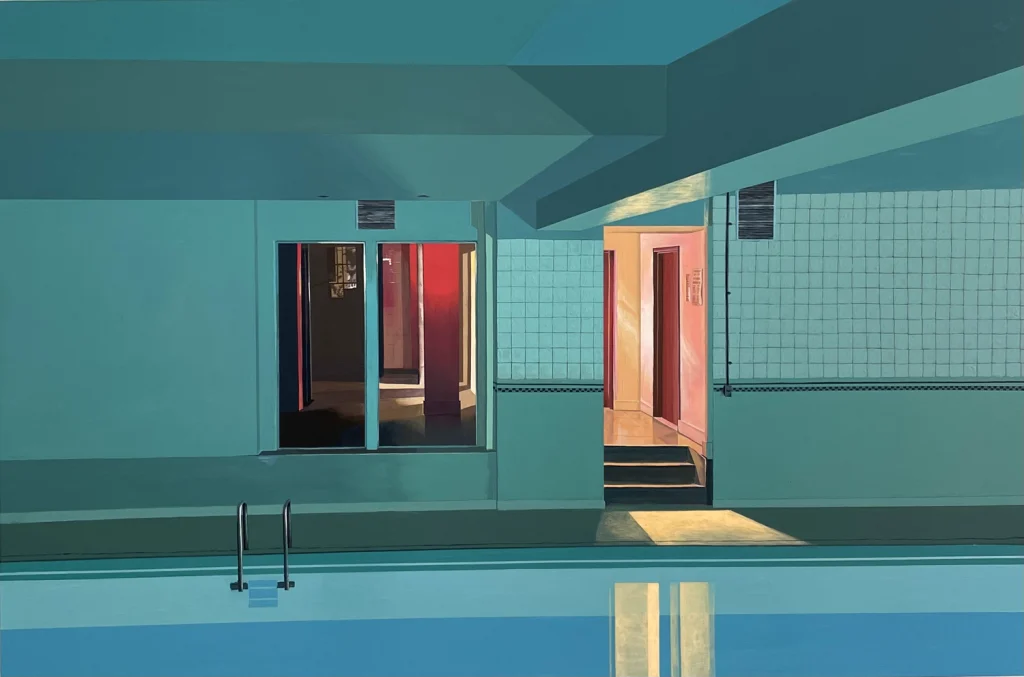
Swim Hour
Acrylic on wood panel
24 x 36 inches | 2024
A single place can hold fragments of memories that collectively form an archive of our lives.
Swim Hour represents such a space. As Green explains, “This painting depicts a hidden swimming pool in Montreal’s Plateau neighbourhood…. I discovered it on one of many nightly walks I would take with a close friend after our classes, as I was still finding my footing and getting to know the city….The pool holds a particular memory of that period, when both the city and our friendship were still unfolding and becoming more familiar. In that way, the painting serves as an archive of a specific time in my life, capturing both my discovery of a place and a blossoming relationship within it.”
Green’s creative process begins with a photograph, sketch or recollection of a space. Next, she reconstructs the space’s interior where specific elements are accentuated while others are altered or removed. Fragments from different rooms and periods of time may be merged into one interior. The questions that arise from Green’s reconstruction of space mimics memory itself, where some aspects of a memory are heightened while others are disregarded. The fragmented pieces that create an image poses questions about memory’s impact on identity through what we emphasise and minimise.
Doors, open and closed, are featured in each space to invite the viewer to impose their own stories and muse about what lies beyond what is seen. Green uses acrylic paint on wood panels. The choice of wood as a support is intriguing since wood has traditionally been used as a building material. In this context, it still is, except that it is building identity and securing the self through the spaces painted on it.
Colour and light form language in Green’s paintings. This technique is reminiscent of Mark Rothko’s and Vincent Van Gogh’s ground-breaking practice in their respective areas. For example, Rothko’s Colour Field Painting, Orange and Yellow (1956) radiates bright orange, yellow and red blocks that represent joy. Van Gogh’s The Bedroom (1888) is a masterclass in using colour to convey a sense of calm.
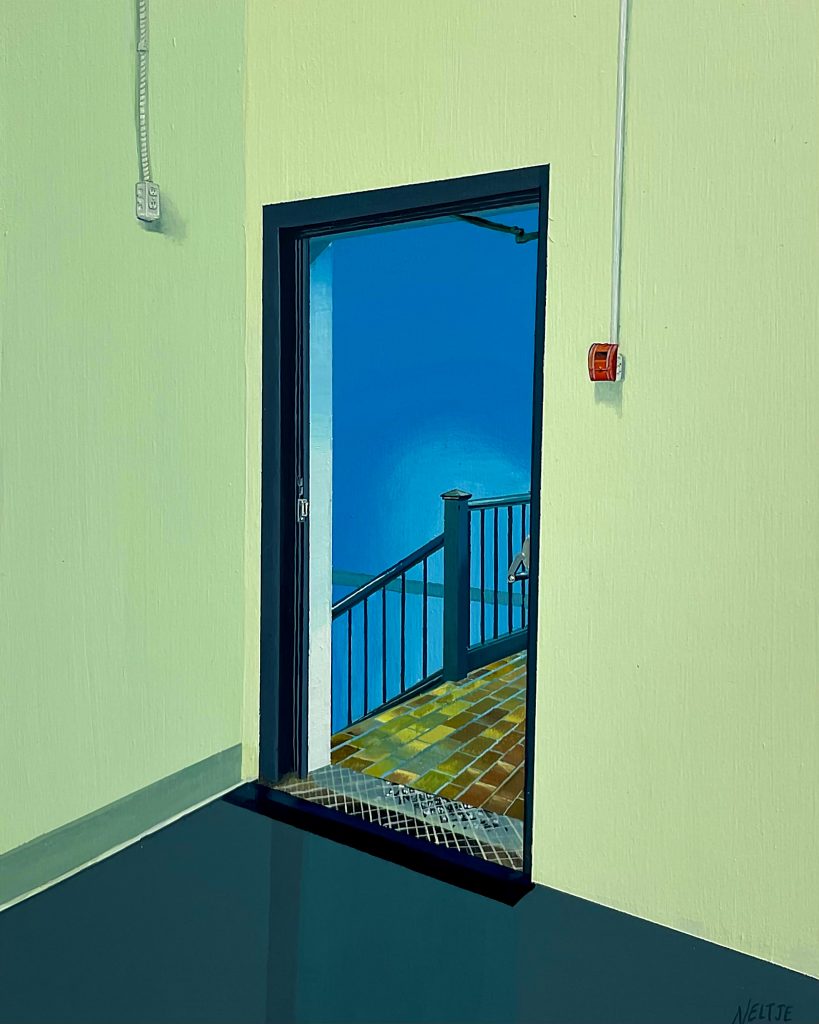
Similarly, Loose Ends discloses the emotions held in the stairwell of Cadbury Lofts, a repurposed chocolate factory in Montreal. Green says, “I’ve always been curious about how old spaces are repurposed, and how a building can take on an entirely new life while parts of it remain almost unchanged.” Lime-coloured walls frame an open door. Speckled tiles seem to emanate remnants of footsteps they once held. Stairs will take you up or down. The green colour brings a feeling of hurriedness and acceleration that teeters on frenziness which is barely anchored by a calm blue stairwell. Radiating cerulean light in the stairwell motions us towards it. Although the bones of the space remain, the original banal wall colours are not portrayed; the colours that speak emotions and actions prevail.
Neltje Green
Loose Ends
Acrylic on Wood Panel
9 x 12 inches | 2026
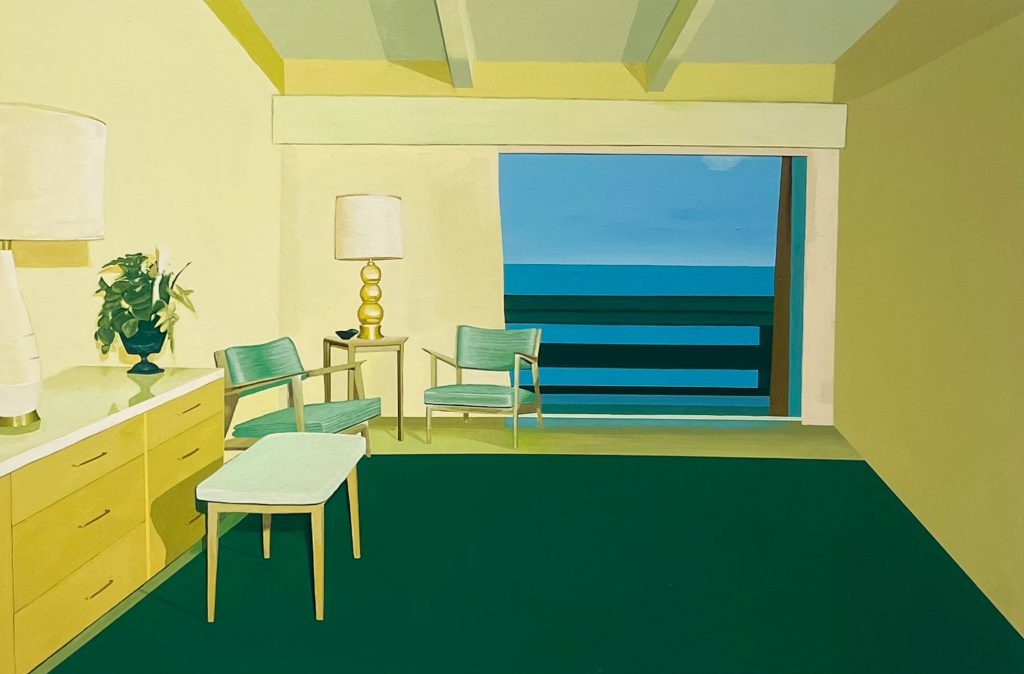
Neltje Green
Lori
Acrylic on wood panel
24 x 36 inches | 2026
Portraiture is the culmination of Green’s paintings. Lori depicts an imagined post-World War II beachside motel, a “luxury” amenity that newly became accessible to wider society. It signalled new adventures and unbridled creativity.
These qualities frame Green’s mother’s influence on her practice. She explains, “In many ways, I think of the painting as a portrait of my mom; not through her physical presence, but through the style and atmosphere of the room. She is also a visual artist, and growing up surrounded by her work and creativity has had a lasting influence on my own artistic sensibilities. I wanted to create a place that felt shaped by that influence, and that could reflect the ways her visual language has become intertwined with my own.”
Green’s paintings have been exhibited in group and solo exhibitions and she has participated in the 2023 Montreal Museum of Fine Arts Residency (Montreal, QC). She has been the focus of several publications including the CBC Arts Newsletter, July 20th (CBC Arts, 2025), Culture: La Foire d’art en plein air de Toronto (Radio Canada, 2025), and Le Hazard: Neltje Green, (AFlots Magazine, 2025). And, continuing to explore new avenues of creativity, she has used her prize money from this SCA exhibition to develop a new series of paintings. Sharing her success, she has donated a painting to be auctioned for the benefit of those living with HIV. Green divides her time between Montreal and Toronto.
Bishop, Janet. Rothko: the Colour Field Paintings. Chronicle Books, 2017
https://www.vangoghmuseum.nl/en/art-and-stories/stories/vincents-colours
https://www.moma.org/artists/5047-mark-rothko
https://www.vangoghmuseum.nl/en/collection/s0047v1962
https://savingplaces.org/stories/retro-roadmap-wildwood-motels-midcentury-modern-for-everybody